Drift 2 Drag
- 4.6
- Rating
- 10.00M
- Installs
- Free
- Price

 Analysis by App-foxy
I went into Drift 2 Drag expecting a quick racing game built around a simple contrast: hold a controlled drift, then turn that speed into a strong drag-race finish. That basic idea is easy to understand, but it takes more attention than the short store summary suggests. The interesting part is not simply driving fast. It is learning when to sacrifice a little control for a better launch, and when a flashy move is actually making the race worse.
Developed by HyperMonk Games, this free racing game is aimed at players who enjoy short, repeatable challenges rather than long simulation sessions. It is rated for Everyone, runs on Android 7.0 and later, and the current version is 5.1.4. The game has built a substantial audience, with over 10 million installs, a 4.5 average from around 181 thousand ratings, and roughly 1.6 thousand written reviews. Those numbers do not automatically make it a perfect fit, but they do match my impression that the central driving loop is immediately approachable.
How the first races establish the real goal
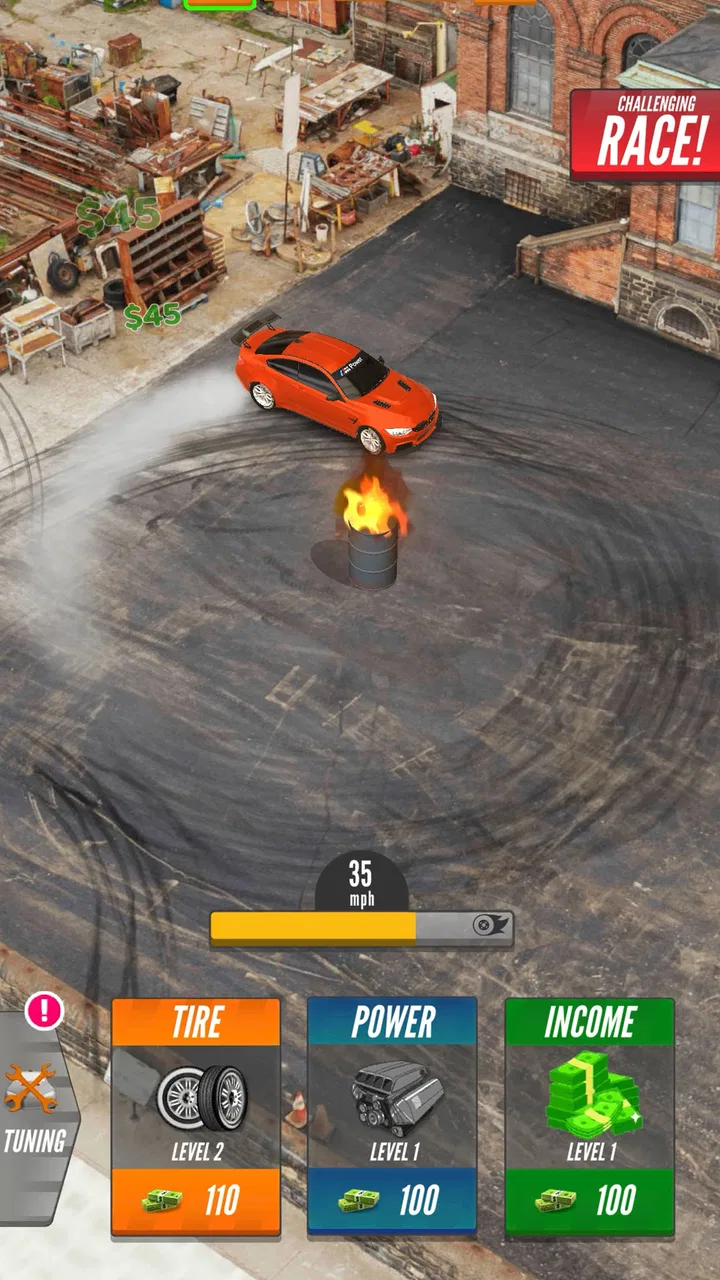
The opening appeal is the clarity of the objective. You are not asked to learn a large collection of racing rules before having fun. The idea is to drift effectively and use that performance to win the race. That gives each attempt a clear question: can I make the turn cleanly enough to arrive at the drag section with an advantage?
You May Also Like

 Blood Strike: 2.5 Anniversary
Blood Strike’s Loadouts Turn Every Drop Into a Tactical Gamble
A close look at Blood Strike’s custom loadouts: how fast access to signature weapons reshapes its battle royale rhythm, rewards preparation, and narrows the gap between fights.

 Pandora - Music & Podcasts
Pandora’s Music Is Easy to Start, but Harder to Recover
Pandora’s strength is its low-effort path from a seed to a station. Its weak spot is how much confidence it asks you to place in connection, setup, and quiet recovery.

 8 Ball Pool
 Is Built on Rivalries, Rematches, and Routine
A close look at the rivalries, rematches, shared routines, and unanswered safety questions that turn a quick pool match into a persistent mobile community.

 Samsung Music
’s Quiet Strength Is Playing What You Already Own
Its reach comes less from spectacle than from dependable access to a personal library. That simplicity is both the app’s strongest retention engine and its ceiling.

 AccuWeather: Weather Radar
AccuWeather Review: A Quick, Clear Forecast for Everyday Decisions
For everyday plans, the best forecast is the one you can understand quickly. AccuWeather makes rain timing, radar, and local conditions easy to act on, with a few trade-offs.

 Hill Climb Racing
Why Hill Climb Racing Still Turns Crashes Into One More Run
A tiny car, a bumpy hill and one more upgrade: Hill Climb Racing keeps resurfacing because its simple chaos makes every near-miss feel personal.
More From Our News Desk



I like this structure because it creates a useful early goal without burying the player in menus or technical explanations. A beginner can focus on staying on the road, while a more experienced player quickly starts looking for better timing and cleaner transitions. The game therefore has two layers from the beginning: basic survival for newcomers and optimization for anyone who dislikes settling for a narrow win.
The first few sessions are best treated as practice rather than a test of reflexes. I found it more productive to watch how a mistake affects the next phase of a race instead of immediately trying to drive aggressively. A drift that looks impressive but ends with poor positioning is less valuable than a modest slide that leaves the car ready for the final push. That is one of the most important lessons to learn early.
A realistic use case is a short break during a commute or while waiting for an appointment. One race can feel manageable when I only have a few minutes, and a failed attempt does not require the same commitment as a full-length console race. At the same time, the short format encourages “one more try” behavior, because the next attempt feels close enough to justify.
Why the drift-to-drag contrast works
The combination of drifting and straight-line racing gives the game a more distinct identity than a conventional lane-based racer. Drifting asks for control and timing, while the drag portion rewards preparation and execution. I am constantly connecting the two instead of treating them as unrelated mini-games.
That connection also creates a useful trade-off. Playing too safely may leave me without enough advantage, but pushing too hard can ruin the transition. The best runs are not necessarily the most dramatic ones. They are the runs where the car exits the turn in a position that makes the next part easier.
This is where the game starts to feel more thoughtful than its compact presentation suggests. The goal is not simply to repeat the same input faster. I have to judge whether the current race is asking for patience or aggression. That judgment becomes especially important when an early error does not end the attempt immediately but makes the remaining section much harder.
What progress feels like during normal play
Progress is communicated less by a long explanation and more by the changing quality of my own attempts. At first, a win feels like getting through the course without losing control. Later, I begin noticing smaller improvements: entering a turn with better positioning, holding a drift more confidently, or recovering from a weak start without panicking.
Those are meaningful progress signals because they are connected directly to driving. I do not need a complicated dashboard to know whether I am improving. If I can repeat a maneuver that previously felt accidental, the game has taught me something useful. That sense of personal consistency is one of its strongest reasons to keep playing.
Players who want a very explicit progression path may find this less satisfying than a larger racing game with extensive vehicle collections, detailed upgrade trees, or a clearly staged career. Drift 2 Drag works better when the player enjoys the act of refining performance. Its appeal comes from making a familiar situation feel more manageable after practice, not from overwhelming the player with a huge amount of content.
I also recommend setting a small goal before each session. Instead of deciding that I must win several races, I might focus on completing one clean drift or improving the transition into the drag section. This makes losses more useful and reduces the frustration of repeating an attempt without understanding what went wrong.
Difficulty, pacing, and the pressure to keep returning
I find the challenge most enjoyable when I treat each retry as a chance to test one decision, rather than as a demand to win immediately. Because races move quickly, it is easy to keep going on autopilot; I get more from pausing after a loss and deciding whether the drift timing or the transition deserves attention next. That small reset helps keep the pace lively without letting repetition turn into pressure.
How the challenge develops
The difficulty curve feels most convincing when the game asks for better decisions rather than simply faster reactions. Early success can come from basic control, but continued success depends on recognizing the cost of a sloppy drift. That gives the challenge a natural shape: first learn what the controls allow, then learn how to use them without wasting the advantage they create.
There is a subtle difference between being unable to perform a maneuver and performing it at the wrong moment. Drift 2 Drag is more interesting when the second problem appears. I may know how to slide the car, yet still lose because I start too early, hold it too long, or leave the turn badly aligned. That kind of failure is easier to accept because it points toward a specific adjustment.
My practical advice is to avoid changing several things at once. If a race goes badly, I would first alter the timing of the drift while keeping the rest of the approach similar. Then I can tell whether the change helped. Randomly driving more aggressively may produce a win, but it does not teach me why the win happened.
The pacing benefits from the game’s compact premise. Races do not need a long buildup before the meaningful decision arrives. This makes the experience friendly to casual play, but it also means players who prefer a slow, immersive racing atmosphere may find it lightweight. There is less room for sightseeing, storytelling, or the feeling of completing a long motorsport event.
Where repetition becomes a strength and a weakness
Repetition is central here. I repeat races because the underlying challenge is easy to understand but difficult to perform consistently. That is satisfying when I can identify a mistake and correct it. It becomes less satisfying when I am retrying mainly because the outcome felt unpredictable or because I am waiting for a better attempt without gaining new insight.
This is the point where personal preference matters. I would recommend the game to someone who enjoys polishing a short technique. I would be more cautious with a player who needs constant changes in scenery, objectives, or race format. The focused loop can feel pleasantly clean, but it can also feel narrow if drifting and drag finishes are not already appealing.
The free entry price makes sampling easy, although the game includes in-app purchases ranging from $1.99 to $99.99 per item. That range is worth keeping in mind before getting deeply invested. I prefer to approach a free game like this by first deciding whether the driving loop is enjoyable on its own, rather than assuming purchases are necessary for a good experience.
In everyday use, that means I would play a few sessions without spending anything and pay attention to whether I am returning because I genuinely want to improve or because the game is creating pressure to continue. If the enjoyment comes from cleaner driving, the free starting point is doing its job. If the main motivation becomes unlocking or buying progress, the value depends much more on individual tolerance for that style of monetization.
Who should choose it, and who should skip it
This is a good choice for someone who wants an accessible mobile racing game with a focused mechanic and short sessions. It suits players who enjoy retrying a course, learning timing, and turning small improvements into wins. It is also a reasonable pick for younger players because its content rating is Everyone, though individual comfort with in-app purchases is still something adults should manage.
I would skip it if my priority were realistic vehicle handling, a large open world, deep car customization, or a long-form racing career. A traditional circuit racer is likely a better fit for players who want lap strategy and sustained races. A more simulation-focused option will suit anyone who cares about detailed vehicle behavior more than quick, readable challenges. Drift 2 Drag is not trying to replace those experiences; it is built around a much tighter loop.
I would also hesitate to recommend it to someone who becomes frustrated by repeated attempts. The game asks me to accept that a small timing error can decide the result. That can be motivating for a patient player, but it may feel unfair to someone who wants every race to progress smoothly. The best audience is comfortable treating failure as feedback rather than as wasted time.
Small habits that make the loop more enjoyable
One useful habit is to separate control practice from winning attempts. On a practice-minded run, I can concentrate on entering the drift cleanly even if the final result is poor. On a serious attempt, I can use the safer timing I have already tested. This prevents every race from becoming an emotional demand to win immediately.
Another is to judge the whole sequence instead of celebrating the drift alone. A strong-looking slide is not automatically a successful one if it leaves the car badly prepared for the drag section. I found that thinking about the transition first changes how I approach the turn. The drift becomes a tool for the race rather than the entire performance.
A third tip is to stop after a short run of uninformative losses. When I am making the same mistake without noticing it, more attempts usually produce frustration rather than improvement. Taking a break and returning later helps me see the timing more clearly. This matters in a game designed around fast retries, because speed of repetition can otherwise hide the fact that I am not learning.
My verdict on the progression and long-term appeal
Drift 2 Drag succeeds when its progression is understood as improving the player’s judgment. The early goal is simple, the challenge becomes more demanding through timing and control, and the strongest progress signal is a run that feels deliberate instead of lucky. That is a solid foundation for a free racing game.
Its limitations are equally clear. The focused format will not satisfy everyone, especially players looking for broad racing variety or a deep simulation. Repetition can become pressure rather than pleasure, and the presence of in-app purchases means I would keep spending decisions separate from the excitement of chasing a win.
Still, I think HyperMonk Games has chosen a smart central idea. The drift is not just decoration before a straight race; it gives the final result context. When I lose, I can usually think about whether the problem began in the turn or in the way I handled the transition. When I win, the satisfaction comes from linking those moments together.
My final recommendation is straightforward: try it if you want a free, easy-to-start racer that rewards repeated practice and compact sessions. Go elsewhere if you need realistic driving, extensive customization, or a constantly changing campaign. For the right player, the real reward is turning a risky-looking drift into a controlled advantage, and that is enough to make another attempt feel worthwhile.
FAQs for Drift 2 Drag
01What is Drift 2 Drag and what makes it unique?
Drift 2 Drag is a racing game that combines the thrill of drifting with the precision of drag racing. Its unique blend of gameplay styles offers players an exciting challenge. The game features realistic physics, customizable cars, and various tracks that cater to both casual gamers and racing enthusiasts, making it stand out in the mobile racing genre.
02Is Drift 2 Drag free to play?
Yes, Drift 2 Drag is free to download and play. However, it includes in-app purchases that allow players to unlock special cars, tracks, and cosmetic upgrades. While these purchases enhance the gaming experience, they are entirely optional and the game can be enjoyed fully without spending money.
03What are the system requirements for Drift 2 Drag?
Drift 2 Drag requires iOS 11.0 or later for Apple devices and Android 5.0 or higher for Android users. It's designed to run smoothly on most modern smartphones and tablets. For optimal performance, ensure your device has sufficient storage and is running the latest operating system updates.
04Does Drift 2 Drag have multiplayer features?
Yes, Drift 2 Drag offers an engaging multiplayer mode where players can challenge friends or compete against others worldwide. The game features leaderboards and various competitive events that allow players to test their skills and climb the ranks, adding an exciting social element to the gameplay.
05How can I customize my cars in Drift 2 Drag?
Drift 2 Drag offers extensive customization options for cars. Players can modify the appearance with paint jobs, decals, and rims. Additionally, performance upgrades like engine tuners, tire enhancements, and suspension tweaks are available, allowing players to tailor their vehicles to suit their racing style and improve their chances on the track.
Pros
- Intuitive controls for easy gameplay.
- Stunning graphics enhance the experience.
- Wide variety of customizable cars.
- Engaging multiplayer mode.
- Frequent updates with new content.
Cons
- Occasional in-app purchase prompts.
- Requires a stable internet connection.
- Some features locked behind paywall.
- Advertisements can be intrusive.
- Limited offline gameplay options.

Drift 2 Drag
Gallery